Well this month the weather has given me all the excuse I need to come in and write my blog. I’m actually writing this two days before the deadline (a miracle) owing mainly to the dull and damp weather we have had the last day or so. The overnight temperatures are certainly starting to push the bees into winter mode and their numbers are dramatically reducing as they do each year. Our large production colonies that may have had 60,000+ workers at their peak just a month or two ago but will now be on their way down to around 10,000.
Our honey harvest is nearly over with just a bit of Heather left to process. Despite the very very dry weather and poor start to the year the bees have generally performed well and yielded lots of honey which is great for us.
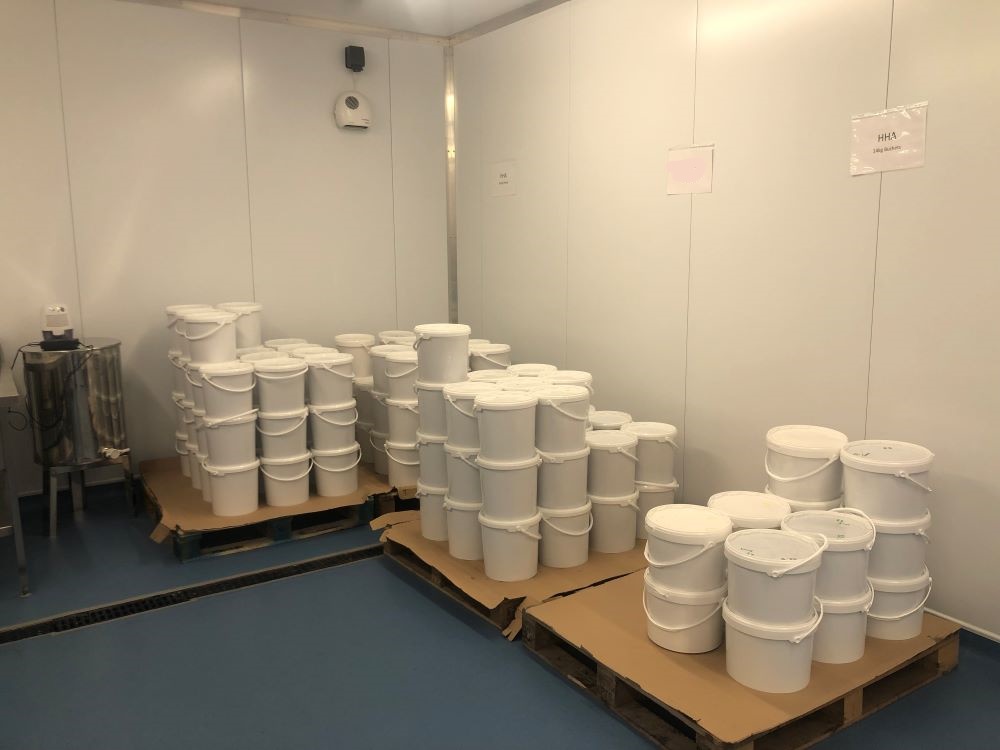
After we harvest the honey we strain it into buckets where it’s stored until we need it. Then we gently warm the bucket up so that it’s runny and it goes through our jarring machine we then hand label it and send it out.
The photo shows some of our honey buckets. For those that have been following for sometime you will know that we had a new much larger honey room last year that was supposed to last a very long time and already it’s looking a bit on the full side!! eek!
The bees are back from their trip up north. Although only last month I was talking about them having gone up to the Peak District this month the heather has finished and the early start was once again happening. Bringing them back is worse though because you have to set off extra early to get the bees loaded up before they start flying. So at 4am off we go. We made great time and loading the trailer only took 40 minutes which was great. Our issue came when we got stuck in traffic on the way home. What the people behind us must have though seeing beehives with bees moving around under the net must have though, I was just glad we put the net on!
Heather is an amazing crop – Dr Adrian Charlton of FERA has found that Heather Honey contains 10x the amount of the essential nutrient Manganese than other honeys. He tested 200 other honeys including Manuka. It is also now the second largest source of Manganese in the world.
If you’ve never heard of Manganese then here is a bit about it: Manganese is an essential mineral. As well as its high antioxidant qualities, it plays a role in helping to make and activate enzymes in the body involved in protecting tissues from damage and in the metabolism of nutrients. It also helps maintain healthy bones.
This month we are a bit quieter on the markets with only two in:
22nd &23rd October – Open Air Country Fair at Planters Garden Centre
23rd October – Market Bosworth Farmers Market
As always thank you for reading our blog, if you have any beekeeping questions get in touch by emailing info@holthallapiary.co.uk